

InCyber ForumCanada 2026.
Booth #708 · 2 and 3 December 2026. The forum runs 1–3 December; Acteron is on the floor on the 2nd and 3rd. If your mandate includes supply-chain security, Zero Trust, or sovereign and regulated workloads, come and see an execution-authorization decision — and hear, plainly, what is validated and what is still design.
Booth #708.
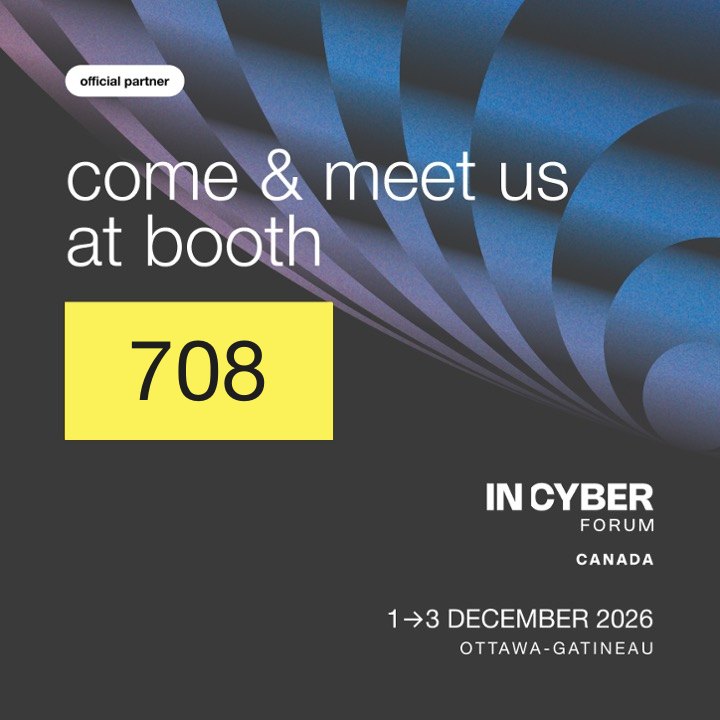
Acteron is a partner of InCyber Forum Canada 2026. The booth is staffed on 2 and 3 December; the demonstration below runs on request, and takes under ten minutes.

A decision at the boundary, from a lab host.
A short demonstration, shown from a recorded or replayed run on a lab host: every figure on screen is the filed run's own record.
The attempt
A governed workload — a package-manager process doing its ordinary job — tries to spawn something it was never authorized to run. The kind of pivot every recent supply-chain compromise used.
The verdict
The attempt is stopped at the execution boundary before the first instruction, and the decision is recorded: what asked, where, under which policy, what was decided. Then the same workload doing its legitimate work — allowed, and also recorded.
The honest part
What you watched is a recording or replay of a controlled run on a lab host, not a production deployment. We will say which parts are validated, which are design basis, and which are target architecture.
Five questions worth asking any vendor in this space. Including us.
Where exactly is the decision made?
Before execution or after? In the kernel or in a user-space agent an attacker can stop? If it is after, it is detection with a fast response — not authorization.
What identifies the artifact?
Its name, its path, its publisher — or its content? Anything but content is a label an attacker can reuse.
What happens before enforce?
Is there an audit-only stage where nothing is blocked and every would-be verdict is recorded? If not, the first false positive is your outage.
What evidence does a decision leave?
A log line, or a record an auditor can trust after the host that produced it is compromised?
What is not covered?
Every honest answer has a scope statement. Ours: SEAP focuses on execution authorization. It does not claim to prevent every exploit inside an already-authorized process, replace memory-safety controls, or make upstream provenance unnecessary.
Four short briefs. Sources included.
The Category
Why execution is the third plane of Zero Trust, and what an enforcement layer for it has to be.
Read →02In Context
What SEAP complements, how it differs, and why it is not application allowlisting.
Read →03The Thesis
Five structural forces and the three-part test for a control plane in its own right.
Read →04The Execution Gap
Thirty years of supply-chain controls, six eras, one recurrent gap — with sources.
Read →If any of these is your mandate.
Public sector and defence
Sovereign, regulated and classified-adjacent workloads that must show only authorized code ran.
Critical infrastructure
Operators whose maintenance tooling and vendor software execute on hosts that cannot afford a surprise.
Platform and DevSecOps
Teams running build runners and package managers that execute code nobody reviewed.
Analysts and integrators
Those mapping execution authorization as a control plane, or embedding an enforcing endpoint in a wider platform.
Book a time
Write ahead and we will hold a slot at booth #708 on 2 or 3 December, or just come by. Technical briefings after the forum are forty-five minutes, in person or remote.
Capability claims reflect architecture, design intent and lab-stage validation, and say which.